
April has been an exciting but also busy month for me. Finally, I finished writing my philosophy thesis and turned it in. I studied Japanese every day for at least an hour and tried to read as much as possible. The most focus was on reading The Divine Comedy (I am almost finished with Inferno) and the Bible. So, in this newsletter, I will officially kick off my Bible read-along, see the notes on Genesis below. But first, let’s discuss the other books that I read in April.
Read in April
On Palestine by Noam Chomsky & Ilan Pappe
I have been interested in the Palestine and Israel conflict for some time and I wanted to read a book that would explain the history behind it. I chose Chomsky’s work because he is the philosopher with whom I feel the most connected regarding ideas. Ilan Pappe was a new author for me. This book is a series of interviews and short essays on the subject. With the current events, it is already a bit outdated, but it is good to go back in history and see a timeline of the major incidents. I would advise you to read it yourself and form your own opinion on the matter. But here are some important statements that Chomsky and Pappe make throughout the book.
First, regarding the whole peace process and end solution. Both proposed solutions, one or two-state, are unfair towards Palestinians. These solutions do not really solve the problem. The peace process has been going on for decades but was never really intended to result in peace. It is just a strategy for prolonging the conflict with other goals in mind.
Second, the very fact that peace negotiations are led by the US explains why these negotiations will never result in peace. The US is a strong supporter of Israel and has never been impartial in the conflict (they sponsor the war). In the meantime, Europe acts like they are blind to the situation.
Third, if Israel continues their ways of conduct, eventually this will be their downfall.
‘’That is why I have often written, since the 1970’s, that the people who call themselves supporters of Israel are in fact supporters of its moral degeneration and probably ultimate destruction’’. – Noam Chomsky
I too think that every regime that is built on the blood and suffering of others is doomed from the beginning.
It is not about choosing a side, resulting in even more segregation between nations, since good people are present in both countries, but about admitting that unforgivable wrong is being done and that this situation should not continue. A change in the governance of both countries should be sought, a change in the direction of viewing citizens as human beings with rights.
Considering the fact that both Chomsky and Pappe are Jewish and have lived in Israel for some time, it is even more striking how critical and unbiased they are in their arguments. Chomsky even admits that it takes great power and self-reflection to acknowledge that your own country is in the wrong.
We- Yevgeny Zamyatin
Original title: Мы
This book was written in 1921 by a Russian author, and it inspired one of my favourite writers, George Orwell, to write his dystopian novel 1984. Unfortunately, I had some difficulties getting through the novel and thus enjoyed it less than I initially had hoped. I read the book in Russian (the original language) on Kindle. The story is told to us, the readers, through a report or journal written by one of the citizens of this dystopian world. He is no ordinary citizen but one who works (indirectly) for the government. A mathematician, working on building the Integral. However, this form of narrative introduces broken sentences and unfinished thoughts into the story which makes the reading experience unpleasant, at least for me. I did enjoy the ending, it was dark and not something that I anticipated.
Zamyatin was a Bolshevik, however, he eventually became just as appalled by the communist regime as he was by the tsar era. His criticism of the government has led to many arrests and imprisonments. We see the same in the story in We. The main character, D-503, works in line with the government but eventually finds himself joining the resistance. This is not because he is such a rebel, but because he meets a woman who is; I-330. She inspires him to dream. The impersonal code names instead of real names, also made the story more difficult to follow. I often found myself wondering who was who. I think that Zamyatin intended to use such names to show the degrading state of these citizens; reduced to mere numbers.
Of course, this book (as was the fate of many other works) was banned by the Soviet censorship board. See here my blog post on other banned books if you are interested in reading such works.
After the illegal publication of We in the West (the book could not be published in the Soviet Union), Zamyatin left the country and eventually died as a poor man in Paris. However, his novel kept on living and inspiring other dissidents.
The Bible Read-Along: Genesis
Welcome to the read-along!
The schedule and more details about the read-along can be found here.
In April, we read the first book; Genesis. It has been a very interesting experience for me since my knowledge so far was only based on the children’s bible that I read decades ago. I hope it was worthwhile for you too to pick up this huge and influential collection of books.
Genesis is one of the books of the Old Testament, the first of the five books of Moses. For the rest of this year and some part of 2026, we will be reading the Old Testament. So a short introduction to this collection of books is needed.
Old Testament
The Old Testament books can be divided into the following categories:
- Books of Law: Genesis, Exodus, Leviticus, Numbers, and Deuteronomy. These are also called the Pentateuch (similar to the Jewish Torah) and are the five books of Moses. It is no longer believed that these books are written by the same person, but by various people over a long period.
- Books of History
- Books of Poetry and Wisdom
- Books of Major and Minor Prophets
These books were written by the Israelites over a period of time (centuries) in mostly Hebrew and Aramaic. In contrast, the New Testament was originally written in Koine Greek.
There is an ongoing dispute on which books should be included in the canon and in what order. The Eastern / Oriental Orthodox Christians (49) include more books in the Old Testament than the Hebrew Bible (Tanakh/ Miqra) or the Protestant Bible (39). The Hebrew Bible only recognizes 24 books, however, this also varies with the divisions in Judaism.
Some canons include these extra books as apocrypha and others leave them out entirely. Note: I’m reading the Authorized King James version of the Bible (Protestant) by Oxford Press University. The extra books are included here as apocrypha.
Genesis (Bereshith)
The Bible ‘’books’’ were actually scrolls and they contained no title. So the name was given by the first word of the scroll. For Bereshith, meaning “in the beginning” was the first word of the scroll. Translated into Latin, it became Genesis.
I think that most people are a bit familiar with the stories in Genesis. Especially the creation story and the life of Adam and Eve in Paradise (Eden). These stories have become universal. But many other stories and details in Genesis are worth exploring. Let’s start at the beginning.
There was nothing until God created the Earth.
‘’In the beginning God created the heaven and the earth. And the earth was without form, and void; and darkness was upon the face of the deep’’.
Later on, this part is disputed again by telling that there were other Gods and nations before this God. One of the names of God is Yahweh (tetragrammaton: YHWH), the only God that Israel should worship. The original pronunciation of God’s name is lost since the Hebrew language at that time contained no vowels. Another name for God is Elohim.
So the story continues with the creation process, which lasts for seven days. The seventh day is the day that God takes his rest.
The created man and woman are placed in the Garden of Eden. The exact location of Eden is unknown, but scholars have named various possible locations: Mesopotamia, the Persian Gulf, or Armenia. Most stories in the Bible take place in the region of the ancient Near East (Mesopotamia) and Middle East, Israel, and Palestine (land of Canaan). Mesopotamia is within the Tigris-Euphrates rivers. So where modern-day Iraq, Iran, Turkey, Syria, and Kuwait are now located.
It is believed that Genesis has two creation narratives written separately from each other. The first introduces the seven days of the creation process. In this narrative, man and woman are created equally. The second narrative starts in chapter 2 and describes the life of Adam in the Garden of Eden. A woman is later on created for him (from his rib) as a companion.
Genesis introduces many generations. If you feel a bit lost in tracking all the names, use this website to view the whole family tree.
The stories in Genesis and the rest of the Bible are probably inspired by older stories, myths, and legends. It is agreed that various ideas come from the Mesopotamian Epic of Gilgamesh.
Adam and Eve
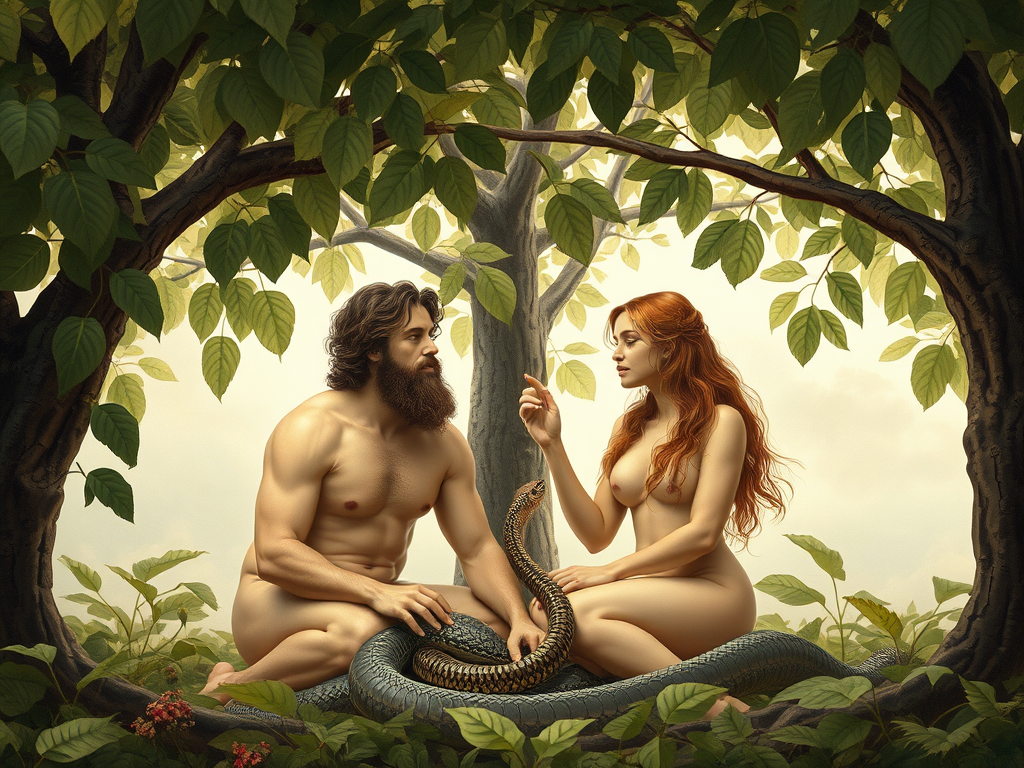
The first people on earth. They are placed in the Garden of Eden. There are various trees, plants, and animals in Eden. Adam and Eve may eat and use all of these resources, except for one tree: the Tree of Knowledge (of good and evil). Another tree also stands out: the Tree of Life in the middle of the Garden.
Eve is seduced by a serpent to eat from the Tree of Knowledge and become just like God. She tells this to Adam and convinces him to do the same. God finds out about this transgression by noticing that Adam and Eve hide their nakedness from him (so they know shame). He curses Eve to bear children in pain and be subordinate to her husband and sends them both away from Eden.
‘’And the Lord God said, Behold, the man is become as one of us, to know good and evil: and now, lest he put forth his hand, and take also of the tree of life, and eat, and live for ever: Therefore the Lord God sent him forth from the garden of Eden, to till the ground from whence he was taken’’.
Two things stood out to me when reading these lines. First, God speaks here in plural, ‘’become as one of us,’’ so there are other Gods with him. Second, the Tree of Life could have given humans eternal life, and this tree was not forbidden to eat from the beginning. Some scholars believe that these trees are, in fact, only one tree. But others see them as separate trees. I, too, read it as two separate trees. The Tree of Life is important in Jewish mysticism (Kabbalah).
After being cast out from Paradise, Adam and Eve began their hard life on Earth. They had two sons; Cain and Abel. Cain worked the fields and Abel was a herder of sheep. Both decided to make offerings to God. God liked Abel’s offering (a sheep) but did not respect Cain’s offering of fruit. Cain became jealous and eventually decided to kill Abel. Cain was cursed and exiled after the murder, he dwelt in the land of Nod. This was probably a reference to the nomad life that Cain had to live, a life without a land. But he did find himself a wife and had a son; Enoch. He named a city after Enoch.
Again in the narrative of Cain and Abel, some things stand out to me. Their story is usually described as the first murder in the Bible. But it is also the first (but definitely not the last!) time that one son was favoured over the other. The hate between brothers starts with Cain and Abel and it never ends. Another aspect is that God had more respect for a blood offering than a fruit-based one. Why?
After losing both their sons, one dead and one in exile, Adam and Eve have a third one; Seth. So since Abel is dead, the human line is continued by Cain and Seth (Adam and Eve probably had other children as well, but these are not mentioned). The children and grandchildren of Cain and Seth resulted in various nations.
Here are a couple of interesting details about these generations. These people live an extraordinarily long time (600+ years) until in chapter 6 God decides to shorten human life to 120 years.
‘’And the Lord said, My spirit shall not always strive with man, for that he also is flesh: yet his days shall be a hundred and twenty years’’. (6:3)
Both Cain and Seth have a Lamech and an Enoch in their generations. The Enoch of Seth’s line will play an important role, while not much is known about Cain’s Enoch, only that he continued the rebellion against God. In Genesis, Seth’s Enoch is described as someone who walked with God and it seems that he did not die in a normal way. Instead, he is taken by God and ascents to heaven.
‘’And all the days of Enoch were three hundred sixty and five years; And Enoch walked with God: and he was not; for God took him’’.
Other biblical texts elaborate more on this. In the discovery of the Dead Sea Scrolls, the Books of Enoch were found. These books, three in total, were not included in the biblical canon (only the Orthodox Ethiopian and Eritrean Church include them) but they explain some mysterious aspects of Genesis. One of these mysteries is the Giants or Nephilim. I will discuss them more in detail below. However, it is believed that the Nephilim were responsible for a lot of violence and corruption on Earth, resulting in God sending the Great Flood.
Noah and the Great Flood
God regrets the creation of man (and Nephilim) and decides to end all life by sending a flood. But he sees that Noah is still a righteous person and wants to save him and his descendants. Noah was instructed to build an ark of gopher wood and make it big enough to fit all animals in pairs.
‘’Of every clean beast thou shalt take to thee by sevens, the male and his female: and of beasts that are not clean by two, the male and his female’’. (7:2)
Other biblical texts elaborate more on which beasts are clean and which are not, but this is not told in Genesis.
‘’In the six hundredth year of Noah’s life, in the second month, the seventeenth day of the month, the same day were all the fountain of the great deep broken up, and the windows of heaven were opened. And the rain was upon the earth forty days and forty nights’’. (7:11-12)
The ark rested eventually on the mountains of Ararat (Armenia or Turkey). After a long while, Noah and his family finally could leave the ark and walk upon the earth again. Noah built an altar for God and made burnt offerings. God made a covenant with Noah and his descendants. Noah had three sons: Shem, Ham, and Japheth.
‘’And will establish my covenant with you; neither shall all flesh be cut off any more by the waters of a flood; neither shall there any more be a flood to destroy the earth’’. (9:11)
The generations of Cain are cut off entirely, and from Seth, only Noah survives. Thus Seth’s bloodline lives on. The narrative continues further by providing the generations of Noah. But first, in chapter 9, it is also mentioned that Noah curses his grandchild, Canaan son of Ham. Again not many details are provided about the reason. However, this event resulted in many historical controversies. Canaan, the forefather of the Canaanites is punished for angering Noah. Noah then says that he will be the servant of Shem and Japheth. One can go down this rabbit hole as well and read the various interpretations of this event (very interesting!), however, I will continue further with the generations of Shem, since these generations have a covenant with God and will be central in the rest of the narrative.
Abraham and Sarah (Abram & Sarai)
God instructs Abraham (originally named Abram) to leave the land of Haran. Lot (son of Haran) accompanies him. They go into the land of Canaan. His wife Sarah comes with him, too. She turns out to be barren, so they have no children for a long time.
‘’And the Lord appeared unto Abram, and said, Unto thy seed will I give this land: and there builder he an altar unto the Lord, who appeared unto him.’’ (12:7)
Abraham and Lot go their separate ways after Egypt (in Egypt, Abraham tricks Pharaoh and acquires valuable assets).
Sarah gives her Egyptian maid, Hagar, to Abraham to conceive children. This way Abraham gets his first son, Ishmael. Ishmael becomes an important figure in Islam; a prophet and the ancestor of Muhammad.
God promises that Sarah will also have her own son. She does not believe him, since she is old and could not have children for many years. But a year later she gets a son and calls him Isaac.
I think this is where things get even darker. In chapter 19, the destruction of Sodom and Gomorrah is told. God visited Abraham and Sarah (making the promise about the child) and sent three angels to Sodom. Lot encounters the angels first and brings them into his house. When angry citizens stand before his door and demand to see the three guests, Lot goes as far as giving away his daughters to the angry crowd… I found this part the most shocking.
Lot is spared by the angels. He, his wife and his daughters are allowed to leave the city. Then the destruction begins.
‘’Then the Lord rained upon Sodom and upon Gomorrah brimstone and fire from the Lord out of heaven; and he overthrew those cities, and all the plain, and all the inhabitants of the cities, and that which grew upon the ground.’’ (19: 24-25).
Lot and his family were also instructed not to look back when they were leaving. But his wife could not restrain her curiosity and looked back. She was turned into a pillar of salt.
The story gets even worse when the daughters of Lot decide to let their father drink a lot and conceive children by him. This results in two children: Moab (Moabites) and Ben-ammi (father of the children of Ammon).
Abraham tells his servant to find Isaac a wife that is not a Canaanite. The servant asks God for help and is pointed towards Rebekah. Isaac marries Rebekah and they have two sons (twins) Esau and Jacob. Isaac favours Esau and Rebekah favours Jacob. Again a very toxic way of parenting resulting in hatred.
I think Jacob is one of the worst characters in the Genesis narrative. He manipulates his brother, Esau, to give up his birthright. Later on, with encouragement from Rebekah, Jacob steals the blessing from his father which was meant for Esau. Esau is enraged and plans to kill Jacob. Jacob decides to leave and hide. Isaac also instructs Jacob not to marry a Canaan woman but to go to Bethuel (Rebekah’s father) and marry a daughter of Laban (Rebekah’s brother).
‘’Arise, go to Padan-arm, to the house of Bethuel thy mother’s father; and take thee a wife from thence of the daughters of Laban thy mother’s brother.’’ (28:2)
Jacob does this and at Bethuel’s house, he falls in love with Rachel.
Esau marries Ishmael’s daughter which angers his parents.
Jacob, Rachel and Leah
Jacob marries Rachel after working seven years for Laban, but on their wedding night, he is tricked into sleeping with Leah. Leah becomes pregnant. He has to work seven more years to get Rachel. This leads to Jacob having two wives: Rachel and Leah. Rachel is jealous of her sister because she cannot give Jacob children herself. She offers Jacob her handmaid Bilhah, and trough her a son is born. Later God allows Rachel to get pregnant as well and she gives birth to Joseph. After some time, Leah decides to also share her handmaid, Zilpah, with Jacob because she thinks she cannot get pregnant anymore. In the end, Jacob has four wives and 12 children.
Jacob leaves Laban and reunites with his brother, Esau (also called Edom; the father of Edomites) for a while. But first, he encounters an Angel (or even God himself) and has a fight with the stranger. After Jacob has shown his power, the angel gives him a new name.
‘’And he said, Thy name shall be called no more Jacob, but Israel: for as a prince hast thou power with God and with men, and hast prevailed’’. (32:28)
So here it becomes clear how Israel, the country, got its name. Jacob/Israel is the forefather of the Israelites. His 12 sons are the Twelve Tribes of Israel. On his deathbed, he gave his blessing to Joseph’s youngest son Ephraim instead of the oldest son.
Joseph
Son of Jacob and Rachel. He is favoured by his parents and hated by his brothers because of this and his dreams. He has dreams of the future, wherein his family has to bow down to him. His brothers decide to kill him but eventually end up selling him as a slave. Joseph arrives in Egypt and is sold to Potiphar (Pharaoh’s officer). Joseph became a wealthy man in Egypt because he is able to explain Pharaoh’s dreams and foresee the upcoming famine. On his advice, Egypt prepares well for the famine and does not suffer compared to other countries. Joseph’s brothers are sent by their father to Egypt to ask for food. They do not recognize Joseph but he of course knows who they are. At last, Joseph forgives his brothers and invites the whole family to come to Egypt and live there.
Jacob, knowing that he would die soon, asks his children to return to the land of Canaan because he does not want to be buried in Egypt. On his deathbed, he gave his blessing to Joseph’s youngest son Ephraim instead of the oldest son Manasseh.
Genesis has many side stories and I could not mention them all and go into more details. This newsletter has already become way too long. In May, we will be reading Exodus, the next newsletter will focus further on Joseph and his children.
Mysterious Characters & Creatures
Nephilim (6:1-4
These are the Giants. ‘’Mighty men of renown’’. Born through the union of sons of God (bene elohim) and daughters of men. The word Nephilim is not mentioned in the King James version but in some other translations that is how the Giants are called. Their corruption and violence are seen as one of the reasons for the Great Flood.
“The earth also was corrupt before God, and the earth was filled with violence”. (6:11)
For me, the Giants are the most interesting aspect of Genesis. I wish that the text told more about their origin. They are only mentioned in chapter 6 briefly and vaguely. Other biblical texts also mention them: the books of Enoch, Jubilees, Genesis Apocryphon (Tales of the Patriarchs), Baruch, the Damascus Document, and Daniel. Furthermore, there is also the Book of Giants. This one is similar to the Books of Enoch.
I like to dive deeper into this subject, so I will try to add the apocryphal books to this read-along and find additional literature on the Giants.
The ‘’sons of God’’ is another mysterious concept. There is no clear answer on who they should represent. An interesting thesis by J.J.T. Doedens is written on this subject (see references). There are four possibilities, they are either:
- Gods themselves
- Angels
- Sons of rulers (virtuous) and daughters of men (wicked)
- Sons of Seth (Sethites), making the daughters of men the daughters of Cain
Most evidence points towards the first interpretation. The sons of God are other divine beings, other Near East worshipped Gods. That’s how I had interpreted this passage too. Such a concept is found in various mythologies, for example, demi-gods. Think of Hercules, son of Zeus and a mortal woman (Alcmene).
Nimrod
It is unclear from the Bible if Nimrod was one of the Giants. He is mentioned in 10:8 as the son of Cush (Cush is the son of Ham, grandchild of Noah) and described as a mighty huntsman and the king of Babel (Babylon). In Dante’s Inferno, though, he is described as one of the giants in the lower parts of hell. It is believed that he built the tower of Babel to rebel against God. For this reason, he and other Giants who rebelled with him are put in the lower part of hell. There, he is not able to speak in coherent language, so no one understands him.
It was supposed that the Great Flood would eradicate all life (except that of Noah and his descendants), resulting in the death of the Giants. But it may be that some Giants remain even after the flood. Other texts will also mention some Giant-like characters.
Cherubims
Their appearance is described in another book, Ezekiel. They have four faces (lion, ox, human, eagle) and eyes all over their body and wings. They could see everything without the need to turn around. Their purpose and tasks are differently described over the three Abrahamic religions and various texts. But in Genesis, they have to guard the entrance into Eden.
“So he drove out the man, and he placed at the east of the garden of Eden Cherubims, and a flaming sword which turned every way, to keep the way of the tree of life”. (3:24).
Literature and the Bible
I have already discussed the reason behind this read-along (pure as literature and expanding knowledge) but the other two books that I have read this month illustrate this reason yet again. The conflict between Palestine and Israel is not only political but also religious. Since the Bible starts out with the creation of the world, stating who the chosen people are, and appointing Israel as the promised land to Abraham’s descendants, it clearly has sparked many religious debates. Noam Chomsky and Ilan Pappe discuss some of these debates in their book. They also explain why religion should not be seen as part of Zionism and have no place in the discussions about the possible solutions.
‘’If you secularize the Jewish religion, you cannot later use the Bible as a justification for occupying Palestine’’. – Noam Chomsky
The Bible cannot be read as a historical book, it may contain various historical events but that is not the same thing. But more importantly, according to Chomsky, Zionism has nothing to do with faith.
In Zamyatin’s book, there are also various references to the Bible and Christianity.
“…Those two, in paradise, were given a choice: happiness without freedom, or freedom without happiness. There was no third alternative…”
An obvious reference to the Adam and Eve story. Eating from the forbidden tree of knowledge gave them freedom since knowledge is freedom of thought, but it took away their carefree happy life.
“And this same Christian, all-merciful God—the one who slowly roasts in the fires of Hell all those who rebel against him—is he not to be called executioner?”
So far, there is nothing merciful about the God in Genesis. The book is filled with violence. Exactly what Zamyatin meant of course in that statement.
Also interesting to note is that in both We and 1984, it is the woman who convinces the man to rebel against the regime. This could be seen as a reference to Eve convincing Adam to eat from the Tree of Knowledge. Without the woman, the man would remain content with the status quo and continue living ‘’comfortably’’.
I think that almost all books (at least the ones that I choose to read) have some reference to the Bible. For example, currently, I’m reading The Divine Comedy by Dante and The Stand by Stephen King. The first one is literary about heaven and hell and is hugely influenced by the Bible. But also The Stand has major religious themes in the story. Thus the section ‘’Literature and The Bible’’ will be a monthly aspect of this newsletter besides all the general reading notes on the text itself.
Further Reading
In this section, I will provide you with books that are inspired by the Bible and can be interesting to read.
Of course, The Divine Comedy by Dante and Paradise Lost by Milton come immediately to mind. Both are indisputably great! But there is more. One that I’m looking forward to reading someday is Joseph and his Brothers by Thomas Mann.
More contemporary work is, for example, The Handmaid’s Tale by Margaret Antwoord, which takes the story of Jacob, Rachel, and Leah and gives it a new spin. I’m currently rewatching the TV show adaptation.
And lastly, a horror novel by Stephen Chbosky called Imaginary Friend that deals with Hell, Adam and Eve, and the Devil.
References
- Wikipedia
- The Authorized King James Bible, Oxford Press University
- The Divine Comedy by Dante Alighieri, Everyman’s Library edition
- Dissertation of J.J.T. Doedens – The Sons of God in Genesis



Discover more from MariaTheMillennial
Subscribe to get the latest posts sent to your email.
 MariaTheMillennial