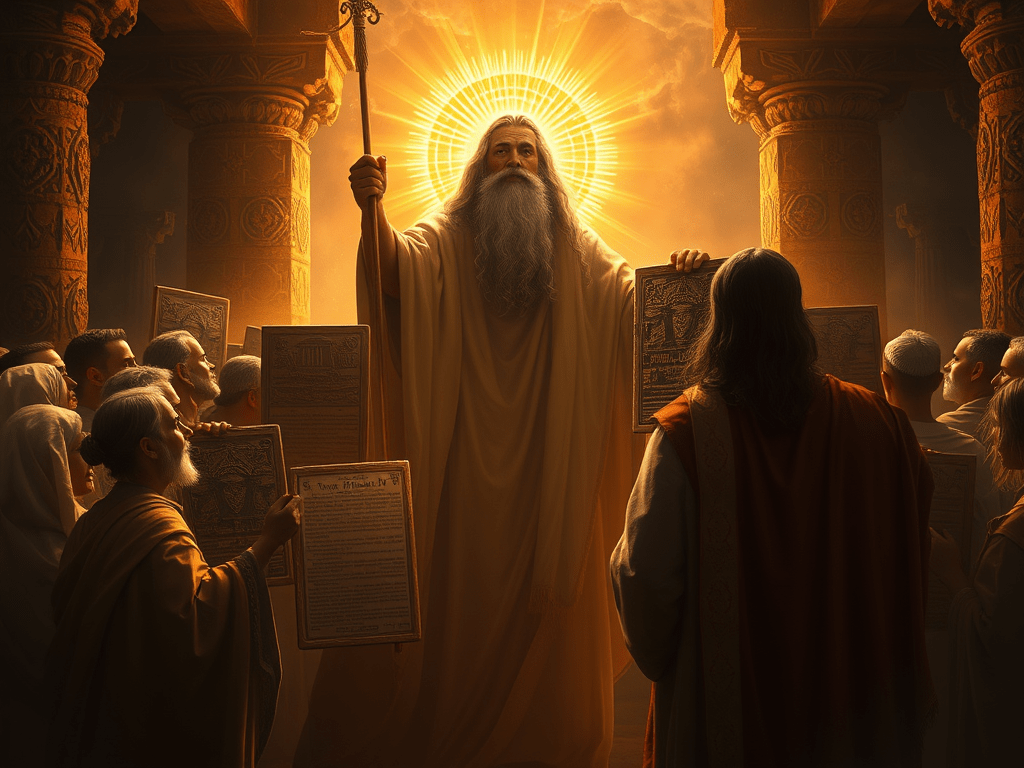
Dear readers, welcome back! In May, we read the second book of Moses from the Old Testament: Exodus. If you missed the notes on Genesis, you can read them in the previous blog post. I decided to split my monthly reading wrap-up and this read-along because the last article got way too long.
Exodus (Shemōt)
The Hebrew name (shemōt) comes from the first word of the scroll, meaning ‘’names’’. Later when it was translated into Greek, it was called Exodus meaning ‘’way out’’ from ‘’path’’ or ‘’road’’ referring to the journey of the Israelites.
Exodus is referred to as the second book of Moses even though the scholars agree that Moses himself did not write it. The Bible’s history is complex and long, many books have been written about it. I chose to accompany my reading experience with another book to have a better understanding of the history, time frame of the events, and the various characters, authors, and translations. It’s called A History of the Bible by John Barton. Barton explains that the Old Testament stories seem to be older than they actually are. They were probably written between the ninth and second century BC. Of course, the stories come from oral traditions and are often seen as folk myths. There is some actual history in them but it is not accurate and thus cannot be interpreted as history.
A large majority of the scrolls were written in Biblical Hebrew, however, some parts were also written in Aramaic; another ancient Semitic language. For a while, Hebrews used Aramaic as their main language and Hebrew was only spoken by a few. So the Bible was translated fully into Aramaic, and these translated editions were called targums. Later, in the twentieth century, the Hebrew language was revived again and Modern Hebrew was created. Modern Bibles follow the Masoretic manuscript, usually the only complete copy that remained: the Leningrad Codex. Original manuscripts were never found, only the copies.
There are not many other historical texts found on the history of ancient Israel and it is hard to fill in the blanks that the Bible does not explain. And as mentioned earlier, due to the various copies and translations of the Bible, you can imagine that the texts are edited by various interpretations and translation mistakes over a long period of time.
Last note on the history of the Bible for now. Old Testament is sometimes seen as a problematic term since it implies that the New Testament is better or more fitting to the current time. Another term is preferred by some: Hebrew Bible. However, since the Bible is not completely written in Hebrew, this is not entirely correct either. I will probably use both terms interchangeably, just as John Barton does. But remember, when one speaks of the Hebrew Bible, it does not include the New Testament since this is part of Christianity and not Judaism.
Let’s continue with the story. As you may remember from Genesis, the sons of Israel were brought to Egypt by Joseph due to a severe famine in the Land of Canaan. That is where they remain for some time until things start to change in Egypt.
Summary of the Events
The new pharaoh, plagues, and living Egypt
The Hebrews were still living in Egypt, in their own territory called the land of Goshen. But their lives became harder due to the rise of a new pharaoh. This pharaoh was not familiar with Joseph and saw the Hebrews as possible enemies. They were treated like slaves and had a hard time under this new regime. Pharaoh wanted to put a limit on the growth of the Hebrew community and instructed midwives to discreetly murder born sons and spare daughters. When this approach did not work, he then decided to openly murder all male infants.
From the Levi tribe, a son is born to Jochebed (daughter of Levi) and Amram (grandson of Levi). Jochebed hides the child as long as she is able. Then she makes an ark of bulrushes, places the infant therein and sends him down the Nile river. Miriam, his older sister, follows and watches him. The daughter of the pharaoh sees the child and saves and adopts him. She names him Moses. There are many speculations about the origins of Moses. Some believe that he was actually an Egyptian (theory of Sigmund Freud) others say that he was half Hebrew and half Egyptian. In the Bible story, he is fully Hebrew but grows up with Egyptian education and values.
Moses is not content with the situation in the land and is concerned for his family and people. One day, he sees an Egyptian hurting a Hebrew, and when no one is watching he kills the Egyptian. Later he finds out that someone did see him and that people know about his secret. He leaves Egypt and dwells in the land of Midian.
Midian is currently in the area of northwestern Saudi Arabia. According to the Bible, the Midianites descend from Midian, the son of Abraham and Keturah. They worshipped various Gods, some that we know of are: Baal, Ashteroth, and Yahweh (God of weather and war). Yes, the same God that created Adam and Eve and made a covenant with Abraham. Yahweh was one of the many other Gods who were worshipped in those areas.
Moses meets the daughter of Jethro (the priest of Midian, also called Reuel), Zipporah, and eventually marries her. They have a son together, Gershom, later a second son is born, Eliezer. Moses starts working for Jethro and lives with him for 40 years before returning to Egypt
But why go back to the land that he escaped? Because he finds the God (Yahweh) of his forefathers (Abraham, Isaac, Jacob, and Joseph) and wants to save his people with God’s help.
‘’And the angel of the Lord appeared unto him in a flame of fire out in the midst of a bush: and he looked, and, behold, the bush burned with fire, and the bush was not consumed’’. (3:2)
Moses spoke with God and was sent back to Egypt to deliver his people from Egypt. Moses asks for God’s name, and gets the following answer: ‘’I AM THAT I AM’’. Of course, there are various other translations of this sentence, this is the translation that the King James edition provides. The essence is that God decides not to share his real name with Moses and that he is known by various other names. In another chapter, he calls himself Jehovah. It is an interesting topic to dive in, so I think that I would like to write a more in-depth article about the various names of God. Each name gives away some information about the time that it was common to use or about the relationship that the people had with God.
‘’And I appeared unto Abraham, unto Isaac, and unto Jacob, by the name of God Almighty, but by my name JEHOVAH was I not known to them’’. (6:3)
Moses asks his brother Aaron for help to convince the future Israelites to follow him out of Egypt into the promised land since Moses is not good with words. Aaron accepts this position and together they start their work.
Moses has the opportunity to speak directly with the pharaoh. This aspect alone shows that Moses was probably not of common origin and thus had some connections with the royalties of Egypt. He shows some ‘’magical’’ tricks to the pharaoh to convince him to let Moses’ people go into the desert and pay tribute to their God. Pharaoh is not impressed and he also realizes that these people do not intend to return. He does not want to let his servants go since they are needed for his building projects.
After the speeches and tricks that do not work, Moses pleads with Yahweh. Yahweh then starts sending various plagues on the people of Egypt (ten in total) to force the pharaoh to let his people go. The passages in these chapters get darker and darker with every plague. The most peculiar thing for me was not the plagues themself but the idea of Yahweh behind them. He did not want to convince the pharaoh with the first plague, he wanted to show everything that he was able to do, with the intention to scare the pharaoh and the people of Egypt. Show off his powers. Thus he did not give the pharaoh a fair chance to think but clouded his mind.
‘’And in very deed for this cause have I raised thee up, for to shew in thee my power; and that my name may be declared throughout all the earth’’. (9:16)
Advertisements
Plagues of Egypt
- Water in the Nile River becomes blood; undrinkable
- Infestation of frogs
- Infestation of gnats/ lice(mosquitos or small flies)
- Wild animals and insects harm Egyptians and their livestock
- Pestilence and death of livestock
- Boils plague
- Severely bad weather: thunderstorms and hail
- Infestation of locust swarms that eat all the food
- Total darkness
- Death of all the firstborns (humans and animals)
The last plague was the worst of all. Then the pharaoh and the Egyptians not only allowed Moses’ people to go but they wanted them gone. In one night, the destroyer of God went around Egypt and killed every firstborn, human and beast, of every house that was not marked with blood. Even the firstborn son of the pharaoh was murdered. The houses that were marked with blood on their door, were spared. These, of course, were the houses of the followers of Yahweh, informed beforehand by Moses and Aaron. They were also instructed to borrow gold, silver, and other valuable things from their neighbours before this night.
‘’And Pharaoh rose up in the night, he, and all his servants, and all the Egyptians; and there was a great cry in Egypt; for there was not a house where there was not one dead’’. (12:30)
God also demands that this night will be remembered and celebrated, a feast called Passover (still celebrated today). For seven days people had to eat unleavened bread and remove all leaven from their household.
According to Exodus, the sons of Israel had lived for four hundred and thirty years in Egypt. The Bible make it seem that the people Moses wants to lead out of Egypt are of one group, the Hebrews. And that they eventually became Israelites in the land of Canaan, named after Israel (Jacob) who made a covenant with Yahweh. However, these people were probably of various descents, they worshipped multiple Gods and spoke different Semitic languages. There is evidence that they were called Habiru in Egypt, servants and rebels who originated from various areas and came to Egypt to work there. Habiru meaning ‘’outsider’’,, also refered to as Apiru. See the interesting article by S. Joseph on this subject. Furthermore, along the journey through the desert and their arrival in Canaan, they encounter other nations and include them into their tribe, for example, Amalekites. John Barton points out that it is even possible that there is no such exile at all and that the people of Canaan always had included the people of Israel, they are the same. And that the exile from Egypt was inspired by older events and mythologies. I think that we would never find out what really happened. But let’s follow the story as told in Exodus further.
Since God had killed all the firstborns to free his people, he claimed all their firstborns (humans and beasts) too. Firstborn male animals had to be sacrificed and firstborn male infants had to be redeemed.
‘’And it came to pass, when Pharaoh would hardly let us go, that the Lord slew all the firstborn in the land of Egypt, both the firstborn of man, and the firstborn of beast: therefore I sacrifice to the Lord all that openth the matrix, being males; but all the firstborn of my children I redeem’’.
Moses leads his people through the desert and continues his contact with God. Pharaoh decided to send an army after them but he and his army were swallowed up by the Red Sea while Moses and his people crossed the sea safely.
God promises to lead them into the land of Canaan and to wage war against the inhabitants of that land.
‘’The people shall hear, and be afraid: sorrow shall take hold on the inhabitants of Palestina. Then the dukes of Edom shall be amazed; the mighty men of Moab, trembling shall take hold upon them; all the inhabitants of Canaan shall melt away.’’ (15:14-15)
There is not a lot to drink and eat in the desert and the people were not well prepared for such a journey. Eventually, they are all out of food and water and start to complain to Moses. Why did he make them leave? To kill them here? So Moses pleads with God again. God made waters in Marah drinkable, made bread rain upon the earth, and gave them manna along the journey.
Battle with Amalek
After some time, they settled in Rephidim; an oasis in the desert. There they have a battle with Amalek and win the fight. Joshua, Moses’ assistant, led the attack and was the commander of their army. Moses stood on a hill with Aaron and Hur. When he held up his arms, the Israelites fought well but when his arms were down, they were losing the war. So Aaron and Hur held up his arms for the whole time the battle was going on.
Amalekites were people who may have lived in the land of Canaan or North Africa, probably descendants of Amalek (grandson of Esau who is the elder brother of Jacob/Israel) or descendants of Ham (son of Noah).
A lot remains unknown about these people. After the battle, Exodus states the following:
‘’And Moses built an alter, and called the name of it Jehovah-nissi: For he said, Because the Lord hath sworn that the Lord will have war with Amalek from generation to generation’’.
This was the first conflict between these two nations, but more will follow throughout the Bible narrative.
Judgement and Laws
The sons of Israel travel further and arrive at the base of Mount Sinai (sometimes called Mount Horeb). The exact location of this mountain is still disputed. It may be that the mountain was an active volcano. At this location, they set up their camp and received the Ten Commandments from God through Moses. The people actually witness God at the top of the mountain (theophany).
‘’And mount Sinai was altogether on a smoke, because the Lord descended upon it in fire: and the smoke thereof ascended as the smoke of a furnace, and the whole mount quaked greatly’’. (19:18)
Moses is then asked to climb the mountain and speak with God. He receives various laws and the demand to build a tabernacle, a moveable worship place, according to the exact details that God provides, so that God may dwell among them.
‘’And let them make me a sanctuary; that I may dwell among them’’. (25:8)
Many chapters of Exodus are dedicated to this cause and it was sometimes difficult to get through all the details and information. Some things stood out to me, various colours or materials that were often repeated. The materials for the altar and the tabernacle had to be of shittim wood, often covered with gold. In the most inner part of the Tabernacle, Holy of Holies, the Ark of the Covenant was kept. This was a religious storage chest, upon it sat the mercy seat on which God could sit (entirely covered with gold and surrounded by two cherubims of gold). The two Tablets of Law were inside the chest.
The following colours are used for the interior of the Tabernacle and the garments of the priests: purple, blue, scarlet, and gold.
Aaron and his sons are chosen as priests who can enter the Tabernacle, make sacrifices, and rule over the people. They have special garments, also in detail described through Moses. Onyx stones are often used too. On two onyx stones, the twelve names of Israel’s children are engraved (the twelve tribes of Israel) and have to be put on Aaron’s ephod.
Bazaleel (son of Uri and grandson of Hur) is chosen by God to be the chief artisan, responsible for building the Tabernacle and the Ark of the Covenant.
After receiving all of these details and the Tablets of Law, Moses descended Mount Sinai and returned to his people. He had stayed 40 days at the top of the mountain.
There he hears about the corruption of his people. While he was away talking to God, his people had demanded from Aaron a new God; a golden calf. They thought that Moses was lost and would not return, and they wanted something to worship.
Moses is so angry, that he breaks the Tablets of Law and smashes the golden calf. He burns the calf, makes a powder out of it and forces the people to drink it. He asks who is on God’s side, and all the sons of Levi gather around him. He instructs them to kill all others.
‘’And he said unto them, Thus saith the Lord God of Israel, Put every man his sword by his side, and go in and out from gate to gate throughout the camp, and slay every man his brother, and every man his companion, and every man his neighbour’’. (32:27)
Around three thousand people were killed.
God instructs again to not worship other Gods and make no idols.
‘’For thou shalt worship no other god: for the Lord, whose name is Jealous, is a jealous God’’. (34:14)
The Laws that Moses explains to his people have some similarities to the Laws of Hammurabi, a Babylonian king. He lived around 300 years before Moses. The writer of Exodus must have been aware of these laws and used them to build on further.
Mysterious Characters & Creatures
Moses
The one that leads the sons of Israel out of Egypt into the promised land. He has two sons with his wife Zipporah: Gershom and Eliezer. There is a controversy around his relationship with Zipporah, some claim that he also had another wife. She was a Cushite princess called Tharbis (ancient Ethiopia, modern-day Sudan) whom he married before Zipporah. This is not accepted as a fact, but claimed by Josephus (Roman-Jewish historian).
Aaron
He is Moses’ older brother and was eventually appointed by God as a high priest. He and his sons (and future generations) are responsible for worshipping God and serving in the Tabernacle.
Miriam
The older sister of Moses and Aaron. She is a prophetess and an important figure in the Talmud; one of the seven female prophets of Israel.
Joshua
Originally called Hoshea, was the son of Nun from the tribe of Ephraim. He becomes Moses’ assistant and eventually the leader of the Israelites after Moses.
Pharaoh
A pharaoh is the name of the ruler in ancient Egypt. The new pharaoh in Exodus is not mentioned by name, but there are speculations that it could be Ramesses II (Ramesses the Great). He was the ruler of Egypt during the nineteenth dynasty. He had many building aspirations and used servants to create his projects. This fits the narrative of Exodus.
Destroying Angel
God tells Moses that he would send the destroyer (mashḥit) during the Passover night to kill every firstborn. It is not clear who this should be. It may be an angel of God, an angel of death, or God himself. Destroying angels are also called memitim.
Thomas Mann speculates in The Tables of the Law that it is actually Joshua who is the destroyer.
The Golden Calf
The Golden Calf is a created idol by Aaron for the Israelites because they asked him for a new God after Moses disappeared. Aaron instructs his people to gather all their gold and makes them a golden calf to worship. Later, the Israelites are punished severely for this transgression.
At first, it seems like the calf is just a created idol without deeper meaning, but this is not the case. Various cultures during those times worshipped sacred bulls. In fact, a major deity in Egypt (the place that the Israelites just left) had such a God named Ptah, the bull called Apis was an incarnation of his spirit. So maybe the people that Moses ‘’saved” lacked guidance and decided to return to another known God to them.
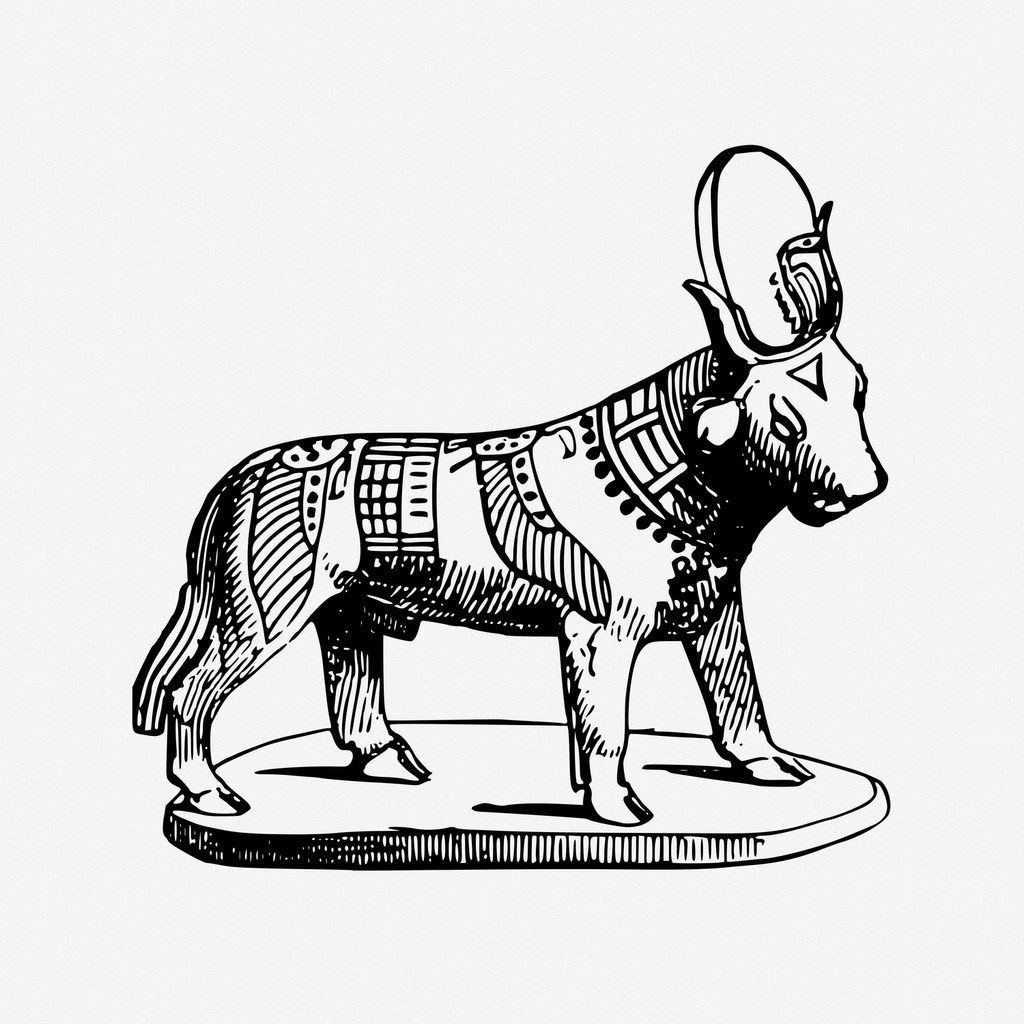
The Canaanites also worshipped a sacred bull. Some scholars believe that the Israelites and the Canaanites are the same people, so they should have been familiar with this God too.
Literature and the Bible
Inferno & Purgatorio
At the beginning of May, I finished reading Inferno by Dante and now I’m continuing on with the second part of the Comedy, Purgatorio. There are no explicit mentions of the book of Exodus in Inferno (various Genesis references are present), but some narrative similarities can be found. Dante’s journey through hell could be seen as a form of exodus. He has to clean himself from sin in hell and purgatory before he can visit paradise (the promised land in Exodus).
In the book of Purgatory, there is one direct reference to Exodus. In the second canto, souls that arrive per boat at the shore of the mount Purgatory, sing a hymn with the following words ‘’In exitu Israel de Aegypto’’. Some of them had to wait a long while before they could enter Purgatory to clean themselves from their sins, similar to the people that Moses leads who have to wait in the desert and learn before they can enter the promised land.
Slaughterhouse-five
There are many references to the Bible in Kurt Vonnegut’s anti-war novel Slaughterhouse-five, but the most striking I found to be the comparison of the bombing of Dresden with the destruction of Sodom and Gomorrah (Genesis) with fire and brimstone.
”Those were vile people in both those cities, as is well known. The world was better off without them. And Lot’s wife, of course, was told not to look back where all those people and their homes had been. But she did look back, and I love her for that, because it was so human. So she was turned to a pillar of salt. So it goes”. – Slaughterhouse-five chapter 1, Kurt Vonnegut
For a long time, many war strategists and people in power defended the bombing of Dresden as a necessary act. Just like the people in Sodom and Gomorrah, they were unworthy of pity since they were the enemies.
The Tables of the Law
Lastly, I would like to highlight another book by Thomas Mann; a novella about Exodus and the Ten Commandments, called The Tables of the Law. I would encourage you to read it since it is short and easy to find online as a PDF. I had already recommended another book by Mann in my Genesis notes, Joseph and His Brothers, so it seems that Mann had found many inspirations in the Bible to write about.
In The Tables of the Law, Mann retells the story of Exodus more ironically. He puts question marks behind many supernatural aspects of the narrative and inserts some alterations to the plot and characters. The book is excellent to read after having read Exodus, it makes the story come alive and explains some details that the Bible leaves unexplained.
Mann describes the moment of the Passover in the following manner, I got goosebumps after reading it.
“This is a dark chapter, one to be voiced only in half-whispered and muffled words. A day came, or more precisely a night, a wicked vesper, when Jahwe or his destroying angel went about and smore the children of Egypt with the tenth and the last plague.” – The Tables of the Law, Thomas Mann
In June, we will be reading Leviticus (the third book of Moses) and you can expect the notes to be posted in the first week of July.
References
- The Authorized King James Bible, Oxford Press University
- The Divine Comedy by Dante Alighieri, Everyman’s Library edition
- A History of the Bible by John Barton, Penguin edition
- The Tables of the Law by Thomas Mann
- The Egyptian Laborers Who Became A Biblical Muse by S. Joseph
- Wikipedia



Discover more from MariaTheMillennial
Subscribe to get the latest posts sent to your email.
 MariaTheMillennial