
Welcome dear readers,
This article is part of the Bible read-along. If you are new here and would like to participate in the read-along, you can find the previous articles and the schedule here. Furthermore, I have made an overview of all the important biblical characters (angels, demons, and humans) who we have encountered so far; you can find it here.
Numbers (Bemidbar)
We are almost done with the Pentateuch; Numbers is the fourth book of Moses, and yes…it contains many numbers! If you had found, like me, Leviticus tedious and containing many repetitions, then brace yourself for Numbers. However, in contrast to Leviticus, Numbers also includes various interesting side stories. Bemidbar, the Hebrew title of Numbers, means ‘’in the desert or wilderness’’. The book combines laws and ritual details (priestly style) with narratives (heroic saga). It even contains a fable element, the story of Balaam and his donkey.
Summary of the Events
Numbering of the tribes
The book starts out with Yahweh instructing Moses to number all of his people as a preparation for war. Note that Moses is permitted to enter the Tabernacle again, after the rules and rituals for offerings and being clean are established in Leviticus.
‘’And the Lord spake unto Moses in the wilderness of Sinai, in the tabernacle of the congregation, on the first day of the second month, in the second year after they were come out of the land of Egypt’’. (Numbers 1:1)
Thus, all the tribes are numbered, and one prince is chosen for every tribe. There is one exception: the Levites, the tribe of Levi. They are not numbered for war but remain as the chosen tribe for serving God and maintaining the tabernacle; pitching and taking down the tent of the tabernacle, overseeing all the rituals and offerings, and judging people when necessary. Eleazar, son of Aaron, is chosen to oversee all of the Levites.
“And I, behold, I have taken the Levites from among the children of Israel instead of all the firstborn that openeth the matrix among the children of Israel: therefore the Levites shall be mine.” (Numbers 3:12)
Since one of the tribes, the Levites, is excluded, there is an empty power seat for one prince. This position is given to another son of Joseph, Manasseh, while Ephraim takes the seat of Joseph’s tribe.
The total number of soldiers ready for war, males of twenty years and above per tribe, is 603.550. The Book of Numbers deals with many large numbers of people through its passages. It seems unlikely that such a large group could wander for years through the desert and be controlled by just Moses and Aaron. If one believed these numbers, then the congregation would consist of 2 to 4 million people. It would be unrealistic to feed, clothe, and control so many people for such a long time (40 years). Scholars conclude that this is not an accurate representation of the actual numbers, like many other aspects of this book.
More laws and rituals
Numbers provides more details on various offerings and rituals. One of these is, for example, the Vow of Nazarite. Through this practice, a person can separate himself to become closer to God. He is not allowed to drink alcohol, cut his hair, or touch death, even when it concerns a family member.
Another custom that stands out is the trial of jealousy. When a husband was jealous or suspicious of his wife, he could bring this matter to the priest. The priest would submit the wife to a trial to show her innocence or guilt. This trial included drinking holy water mixed with dust from the tabernacle… If the woman became sick from this water, then she was guilty. Above everything else, such customs based on superstition must have made life quite difficult for some people, especially women.
Complaining
The congregation started their journey towards the Promised Land. They travelled when the tabernacle was not covered by a cloud, and stayed in a place when the cloud appeared. This could be for days, weeks, or even months. The cloud represented Yahweh, and in the evening it was lit by fire.
Soon, people started to complain to Moses about their hardships. The lack of food and water was starting to take its toll on them again. Yahweh heard all of these and became angry with his people. Through his fire, he consumed some groups of the congregation. Then he also sent a plague to punish them.
Miriam and Aaron started speaking against Moses because of his Ethiopian wife. It is not clear from the text if Moses had two wives or if his first wife was of Ethiopian origin. We know that she was a Midianite and her name was Zipporah (daughter of Jethro). There are theories that he did have two wives, while the new laws imposed by Yahweh forbade this. The second wife is claimed to be a princess from Kush called Tharbis.
Yet, Yahweh did not choose Moses’s siblings’ side and even punished Miriam by giving her leprosy. She was shunned from the camp for seven days.
Spies in Canaan
Yahweh instructs the Israelites to send spies into Canaan. They send twelve, each from every tribe (except the Levites). When the spies return, they tell about the good resources of the land. However, they are also overcome by fear; it turns out that Canaan’s cities are guarded and walled. The people there are strong, and some resemble giants. Yes, the same giants that we already encountered in Genesis.
‘’And there we saw the giants, the sons of Anak, which come of the giants: and we were in our own sight as grasshoppers, and we were in their sight.’’ (Numbers 13:33)
This news resulted in panic and chaos in the congregation. How could they defeat such people and claim their land? Some of the congregation decided to return to Egypt. Yahweh was livid. Such disobedience could not be allowed from his people, and he wanted them all dead. He would start anew, create a better nation, one that would believe in him. Yet again, Moses succeeded in convincing him to show mercy. Still, the rebels had to be punished. Yahweh cursed this generation to wander for forty years in the wilderness, dying there, without ever reaching the Promised Land. Only their children would have a chance to enter Canaan. Two of the spies, Joshua and Caleb, did not anger him and did not receive this curse.
‘’Your carcasses shall fall in this wilderness; and all that were numbered of you’’. (Numbers 14:29)
Balaam and his donkey
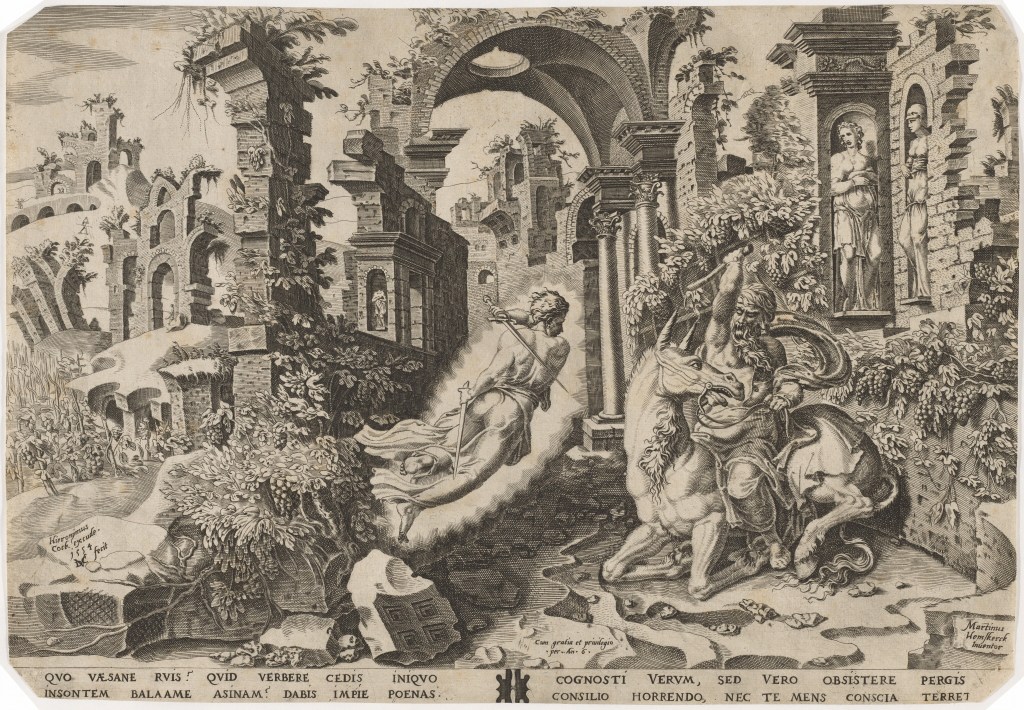
Balaam, a great seer among the Midianites at the time, was asked for help by the Moabite King Balak. Balak wanted Balaam to curse the Israelites to win the war against them. But Balaam could only say what Yahweh permitted him to say. While on his way to Balak, he was even opposed by his donkey. The donkey refused to continue while the road, in Balaam’s view, was empty. Eventually, the angel holding a sword at the end of the road showed himself to Balaam, highlighting the irony in the uselessness of consulting a seer who cannot even see the danger at the end of the road while his donkey can. Balaam ends up blessing the Israelites three times instead of cursing them. Later in the story, he still ends up being killed by them during the war against the Midianites. The Midianites were nomadic tribes who dwelled in the area near Canaan. They were the descendants of Midian, son of Abraham and Keturah (second wife after the death of Sarah). Moses’ wife was from a Midianite origin (other sources claim that she was Ethiopian, though I tend to also read the text as if the Ethiopian woman was his second wife). In Chapter 31, the Israelites attack the Midianites and win the war. They take women and children hostage and bring them back to Moses. Moses is angry with this decision and commands that all male infants and women who are not virgins be killed. They take their possessions and the remaining people with them.
The fate of Miriam, Aaron and Moses
Miriam and Aaron both die in the desert before reaching the Promised Land; she in Kadesh and he at Mount Hor. Moses would suffer the same fate and give his leadership over to Joshua, but this does not yet happen in Numbers. All because of their rebellious acts against Yahweh. Moses ends up not listening to Yahweh’s instructions, blinded by his anger towards the congregation for their constant nagging. He struck a rock with Yahweh’s rod to produce water while he was instructed to speak to it.
Moses’ congregation’s journey ends in the plains of Moab (near the river Jordan) in Numbers. Two tribes, that of Reuben and of Gad, decide to claim the land of Jazer and the land of Gilead (chapter 32). Their wives and children settle there, but the army (so all of the men) can only return when war is won and Canaan is claimed. Deuterenomy continues the narrative. The story of these settlers will be completed in the Book of Joshua.
Mysterious Characters & Creatures
Children of Anak
This is another reference to the giants or Nephilim, who were mentioned earlier in Genesis. It turns out that not all of the Nephilim were killed during the Great Flood; Anak survived and continued his gigantic descendants (Anakim). Three of them are mentioned in Numbers: Ahiman, Sheshai, and Talmai. They lived in the southern part of Canaan, near the city of Hebron, and were also part of the Rephaim.
Another giant is mentioned in Numbers, Og of Bashan, the Amorite king of Bashan. It is not clearly stated that he was a giant; however, in later books, he will be mentioned again as someone of great height and strength (’’tall as cedar trees’’ and ‘’the last giant of the Rephaites’’, Book of Amos).
‘’And the Lord said unto Moses, Fear him not: for I have delivered him into thy hand, and all his people, and his land; and thou shalt do to him as thou didst unto Sihon king of the Amorites, which dwelt at Heshbon. So they smote him, and his sons, and all his people, until there was none left him alive: and they possessed his land.’’ (Numbers 21:34-35)
In Deuteronomy, Joshua will slay the children of Anak, but some will remain in three cities (Gaza, Gath, and Ashdod). It is believed that the Giant Goliath from Gath, whom King David will fight, is one of the descendants.
Baal
The word Baal means lord or owner in the ancient Semitic languages. It was often attributed to various deities in Canaan (Palestina) and other nearby areas. El was the highest God; however, Baal had major influence due to being a storm God and thus responsible for rain and fertility. Another God who is usually associated with Baal and may be the earlier version of him is Hadad. Both had the bull as their symbol.
In Numbers, Baal-peor is mentioned. He is a deity of the Moabites. When the Israelites camped near Mount Peor, their man slept with Moabite women and were seduced to worship Baal-peor. This God is different from the other deity called Baal (Baal-shamem), who was worshipped by Canaanites and Phoenicians.
“And Israel abode in Shittim, and he people began to commit whoredom with the daughters of Moab. And they called the people unto the sacrifices of their gods: and the people did eat, and bowed down to their gods. And Israel joined himself unto Baal-peor: and the anger of the Lord was kindled against Israel” (Numbers 25:1-3)
An ancient text named The Cycle of Baal is a Ugaritic epic which was found in the 1920s in modern Syria, written on six clay tablets, unfortunetely it was incomplete due to destruction. In this epic, Baal fought with other Gods, for example, Yamm, the god of chaos and sea, and Mot, referring to death itself. Baal was sometimes named the rider of the clouds.
Some even see Baal as the precursor of Yahweh.
Christians started referring to Baal as Beelzebub (the Lord of Flies), resulting in new myths surrounding him. This is probably because the Israelites started mocking Baal by changing his name to Ba’al Zabub/ Baʿal-zəvuv of Ekron. Later, in Christianity, he became a demon, the prince of Hell, with legions serving him. Sometimes, even a synonym for Lucifer and Satan.
Unicorns
I was very surprised when I encountered the word “unicorn” in the Bible. This is the translation that King James’s version and some other versions use for the Hebrew word Re’em. As with so many mysterious creatures and figures we have encountered so far, it is unclear what re’em actually referred to. This animal is mentioned nine times in the Bible, and two of them are in Numbers.
“God brought them out of Egypt; he hath as it were the strength of an unicorn.” (Numbers 23:22)
In chapter 24, this passage is repeated to emphasise the strength of Yahweh again.
Re’em could refer to a wild ox or bull, a buffalo, or a rhinoceros. Others claim that it referred to aurochs, an extinct wild species of cattle. If there is a connection between Hadad, Baal, and Yahweh, then it would make sense to translate it as a wild bull, since the bull was a symbol for these three gods. It was also the symbol of El. Translating it as unicorn seems odd.
Literature and the Bible
I have not found direct references to Numbers while reading other books last month. However, now that I’m almost finished with The Stand by Stephen King, I see more similarities between the post-plague community and the Israelites in the desert. Both groups of people are large and growing. They both come from a crisis, an apocalypse versus exile from Egypt, and have a goal in mind: defeating the Dark Man versus defeating the Canaanites. In both stories, the communities decide to send spies to see the land and the enemy. And both groups discover in fear that the enemy seems stronger compared to them. Of course, the major difference is that the Dark Man is a real threat while the Canaanites are not, since they are the rightful inhabitants of Canaan. They have no chance of survival according to the god of the Israelites.
“But if ye will not drive out the inhabitants of the land from before you; then it shall come to pass, that those which ye let remain of them shall be pricks in your eyes, and thorns in your sides, and shall vex you in the land wherein ye dwell. Moreover it shall come to pass, that I shall do unto you, as I thought to do unto them.” (Numbers, 33:55-56)
Both stories are concerned with building a new civilisation and changing the old ways. But is it even possible to control such a large group? And is it morally good to manipulate and even force them into submission and obedience? Personally, the congregation in the Bible do not seem to me as ‘’the good guys’’, it would be difficult to defend their position, I think. On the other hand, in The Stand, the community is clearly depicted as the better people compared to the followers of the Dark Man. But is this really true? Are the good guys always entirely good? Sending an old man, a mentally vulnerable person, and a woman alone as spies to a certain death and probably torture. All for the greater good? It feels immoral to me. I think that Stephen King wanted to highlight that sometimes good people have to make difficult choices (immoral choices) to achieve the end goal (the one that is deemed to be good). But I disagree. We cannot build a better and more peaceful future on immoral acts, especially ones that require innocent blood to be spilt.
References
- The Authorized King James Bible, Oxford Press University
- A History of the Bible by John Barton, Penguin edition
- The Oxford Illustrated Companion to the Bible by Bruce M. Metzger & Michael D. Coogan
- GIANTS IN THE LAND: A BIBLICAL THEOLOGY OF THE NEPHILIM, ANAKIM, REPHAIM (AND GOLIATH) by Zachary Garris
- Wikipedia



Discover more from MariaTheMillennial
Subscribe to get the latest posts sent to your email.
 MariaTheMillennial
Lieve Masha,
Dank voor het iedere keer toezenden van je nieuwsbrief. Ik heb je analyse over “Numbers’ gelezen en ik vond dat je een en ander goed hebt verwoord. Ik heb Numeri nog niet gelezen, afgezien van de keer dat ik in een verleden de Bijbel min of meer heb gescand. Ik heb destijds de Bijbel niet zo intensief gelezen als jij nu doet en ik zelf van plan ben. Ik vond je analyse deze keer interessanter dan de vorige keer, maar dat heeft natuurlijk ook te maken met het soort boek dat je analyseert. Ik denk dat je op den duur misschien wel een boek zou kunnen uitgeven waarin je jouw analyse van de Bijbel weergeeft. Er zijn tenslotte al duizenden analyses op de markt gebracht.
LikeLiked by 1 person