This article is part of the Bible read-along. If you are new here and would like to participate in the read-along, you can find the previous articles and the schedule here. Furthermore, I have made an overview of all the important biblical characters (angels, demons, and humans) who we have encountered so far; you can find it here.
Here we are, the last book of the Pentateuch: Deuteronomy. It feels like an accomplishment even if we still have a long way to go. For now, I will take a small reading break and continue the read-along in January 2026.
Deuteronomy (Dəḇārim)
Many readers will agree that this book contains the most repetition. Various aspects of previous books are revisited here, and a summary of the events from the Egyptian exile to the wilderness journey is provided at the beginning of the book. This should not come as a surprise if you are familiar with the Ancient Greek meaning of the word ‘’Deuteronomy”. It is sometimes translated as “second law”, but this is not entirely correct. A more fitting translation is “repeated law” because previously established laws are repeated here. Still, they also receive more substance from additional details and explanations.
The old Hebrew title, Dəḇārim, means ‘’words’’ because that’s how the text starts: ‘’These be the words which Moses spake unto all Israel…”
The Hebrew Bible, or Old Testament, provides three codes of law for the people of Israel and, to some extent, for Judaism: the Covenant Code, Deuteronomy text, and Holiness Code (Leviticus). The Covenant Code is given in Exodus; it is the oldest biblical law code. Deuteronomy expands on these texts and adds new rituals and laws. The Holiness Code, as presented in Leviticus, is primarily concerned with rituals and sacrifices, likely intended as a guidebook for priests, and is less concerned with social laws. The Ten Commandments (Decalogue) stand on their own and seem to contain more general rules that could be found in various societies of that time. These books are of great importance for Judaism since no other book of law or guides about the living conditions and worship practices were found from that time and place.
Advertisements
Summary of the Events
The book starts in the plains of Moab, near the river Jordan. Moses is giving his last speech to the Israelites, after 40 years of wandering in the wilderness. He summarises their journey and goes through all the rules and rituals again. The most important law seems to be the prohibition of the worship of other Gods. The Israelites must have been returning to their old Gods multiple times throughout their journey out of Egypt. Now they are instructed to remember the ten commandments, to do the offerings, and to never dare to praise other gods. The last part of the speech, called the Song of Moses, describes the different futures the Israelites could have: one where they remain faithful to Yahweh and prosper and one where they go astray and are cursed. However, it seems that Moses knows that his people will abandon the commandments and corrupt themselves once more after they have entered Canaan and received their inheritance.
“For I know that after my death ye will utterly corrupt yourselves, and turn aside from the way which I have commanded you; and evil will befall you in the latter days; because ye will do evil in the sight of the Lord, to provoke him to anger through the work of your hands.” (Deuteronomy 32:29)
In my opinion, the overall tone of Deuteronomy is negative. Moses is quite certain that his people will rebel again, the punishments for various transgressions often result in death (by stoning), and the Israelites are multiple times reminded that they have to wipe out whole populations in Canaan, they may not even spare the children. They are instructed to completely destroy the following tribes: Hittites, Amorites, Canaanites, Perizzites, Hivites, and Jebusites (Deuteronomy 20:17).
Furthermore, when they arrive in Canaan, they have to put blessings on Mount Gerizim and curses on Mount Ebal. Later, the blessings and curses are explained in more detail, and the list of curses is much longer in comparison to the blessings. It basically boils down to the following: if the Israelites offend Yahweh, he will undo their liberation from slavery, and they will return as slaves to Egypt and be cursed.
Thus, Deuteronomy serves as a guide or law book to the Israelites. The actual invasion of Canaan starts in the next book: Joshua. But here, the people are still being prepared for the war.
“This day will I begin to put the dread of thee and the fear of thee opon the nations that are under the whole heaven, who shall hear report of thee, and shall tremble, and be in anguish because of thee.” (Deuteronomy 2:25)
The Israelites are also told not to follow the people in Canaan in their way of sacrifice, which included the sacrifice of children. They are prohibited from consulting fortune tellers, witches, wizards, or necromancers (Deuteronomy 18:10-11). And that one day, a prophet will arrive to lead them. Christians interpret this passage as a prophecy about the coming of Jesus.
“The Lord thy God will raise up unto thee a Prophet from midst of thee, of thy breathren, like unto me; unto him ye shall hearken.” (Deuteronomy 18:15)
Furthermore, once they occupy the land of Canaan and start living there, a worship place (a temple) should be built there where Yahweh would instruct. Eventually, this important place of worship will become Jerusalem.
Mysterious Characters & Creatures
Sheol
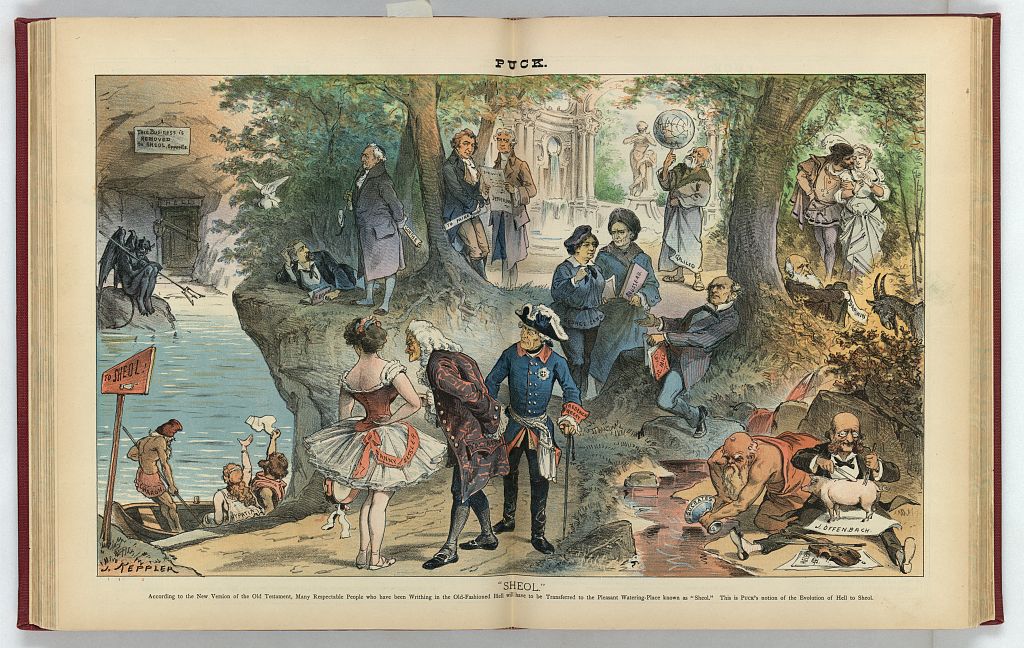
Sheol is translated as hell in the King James version. But this Hebrew term does not refer to a hell as Christians know it. Sheol has more resemblance to the Greek view of the underworld (Hades): a dark and shadowy place wherein all the dead dwell. There is no different destination for the righteous and true believers; everyone ends up in the same place. This concept changes later in Judaism with the introduction of a place for divine punishment of the wicked called Gehenna.
Sheol is mentioned multiple times throughout the Bible. In Deuteronomy, it serves as a description of the wrath of Yahweh.
“For a fire is kindled in mine anger, and shall burn unto the lowest hell, and shall consume the earth with her increase, and set on fire the foundations of the mountains.” (Deuteronomy 33:22)
Sheol By Joseph Keppler. Library of Congress Catalog
Children of Belial
This term refers to the wicked or worthless people who offended Yahweh by their worship of other Gods. In other biblical texts, it refers to various specific characters, for example, the sons of Eli (Hophni and Phinehas).
“Certain men, the children of Belial, are gone out from among you, and have withdrawn the inhabitants if their city, saying, Let us go and serve other gods, which ye have not known.” (Deuteronomy 13:13)
Belial is later used by Christians as another term for Satan or the devil, but in Hebrew it means ‘’worthlessness”. In the Occult and Esoterica, Belial is seen as a demon. He is mentioned in The Lesser Key of Solomon, Crowley’s Goetia, and in LaVey’s Satanic Bible.
Giants (Emims & Zamzummims)
Back to the giants again. In Deuteronomy, there is once more mention of the giants, but they are called by different names here. The text explains a bit about the various names; however, it is not clear whether it was different tribes of giants or different regions that had other names for them.
“The Emims dwelt therein in times past, a people great, and many, and tall, as the Anakims; Which also were accounted giants, as the Anakims; but the Moabites call them Emims.” (Deuteronomy 2:10-11)
The Israelites are warned not to fight with the Moabites since Yahweh will not give them that land. The same applies to the Edomites (people of Esau) and later also to the children of Ammon. The area of the Ammonites had giants, too.
“That also was accounted a land of giants: giants dwelt therein in old time; and the Ammonites call them Zamzummims.” (Deuteronomy 2:20)
Literature and the Bible
A community needs laws; it needs guidance and advice from more experienced and reflective individuals (usually a circle of multiple of these individuals; a council). Returning to The Stand by Stephen King, we see how important this is. People are lost when no one is ruling them. In The Stand, after more people have joined the community around Mother Abagail, a small council is formed. The first thing that they do is organise a town meeting and recite the Constitution. They believe that this would establish some law and order, resulting in less chaos in their newly built society. People need to be reminded often that there are limits to their behaviour and that other people’s rights matter. Even the other side, led by evil (Randall Flag), required laws. Evil cannot prevail without order, too. Think about Dante’s Inferno, the most organised place is indeed hell. But the established laws are reinforced by fear and pain instead of moral ideas and fairness.
When everything falls apart, people are free to do what they want and not everyone has a moral compass. The need for rules is as old as humanity. That’s what we see in The Bible, too. Moses also wants to establish a new community. He gathers and moves the people out of Egypt, lets them wander for forty years, imprints new rituals and laws on them and waits until the older generation is dead to continue with the new and more manageable one: their children. The larger the group gets, the less control there is. Then the need for punishment arises. In The Stand, they choose someone to administer “law and order”, and a sort of police system is established. Moses gives this function to the priests and, on the lower level, to certain individuals who were allowed to judge. A certain moral system is created. For example, one witness is not enough to claim that someone is guilty; there needs to be at least two. People are also instructed to help the poor and those who are on their own. Some cities are appointed to be ‘’refuge cities”, where murderers can run to when they have committed an accidental murder. So the Ancient Israelites already made a distinction between murder and manslaughter.
The community in The Stand had something to fall back on: the Constitution. The Israelites, led by Moses, were still discovering the wheel. There is evidence that they have used and were inspired by other older laws and rule systems (for example, the Hammurabi Code), but still, they were largely on new terrain in this matter.
Advertisements
Some notes on the read-along
I started this read-along for various reasons. The main reason was to remain motivated, continuing to read The Bible and learn about its history. Writing these summaries and reflections helps me to stay focused on the reading schedule that I have created for myself and you. I also like writing reviews and reflections about books, that’s why I created this blog in the first place. And since the Bible has been of major influence on various works of literature, it seemed only logical to read this book at least once in my life. But these are not all the reasons. In addition, I always had an interest in the occult, paranormal, demonology, and esoterica. Obviously, most of these concepts have an origin in the Bible, especially the Hebrew Bible. That’s why I have included the section “Mysterious Characters & Creatures” in the read-along articles, which will be more focused on these themes. And lastly, I hoped to get more insight into the conflict between Palestine and Israel, since a lot of it has its roots in religion.
After reading the first five biblical books, I can conclude that the Abrahamic religions are not something that I could have faith in. Even though I find the texts very interesting and important to read, due to the interests I mentioned earlier, I could not believe in a god that has such origin stories. Let me elaborate on this a bit more. The Ten Commandments do not apply to all the people on earth, like Christianity sometimes claims, only to the followers of Yahweh. I have found many problematic passages throughout my reading, but this seems to be the major issue for me. The commandment “do not kill” seems to exclude the majority of Earth’s civilisation for the Ancient Israelites. The same could be said for Christians in their crusade era or witch-burning phase.
“For the Lord thy God is a consuming fire, even a jealous God.” (Deuteronomy 4:24)
I will not dwell on the theological debates and controversies in this read-along, since a lot has been said about these subjects by others who are more educated than I am on this matter. However, I can imagine how the Bible has led or added to the division of humans and created wars. Throughout my reading, so far, I have found no spiritual inspiration or moral guidance, but I did discover more about the book’s history and also the history of ancient people. The interesting additional texts have helped me in the latter matter; see my references for more recommended reading.
References
The Authorized King James Bible, Oxford Press University
The Divine Comedy by Dante Alighieri, Everyman’s Library edition
A History of the Bible by John Barton, Penguin edition
The Oxford Illustrated Companion to the Bible by Bruce M. Metzger & Michael D. Coogan
The Book of Magic: From Antiquity to the Enlightenment by Brian Copenhaver



 MariaTheMillennial