
Almost all of my Japanese language learning is happening online and through technology. Which is strange for someone who loves books so much. However, I think that at the beginner or even intermediate level it is important to use easy and comprehensive content to stay motivated. Reading books is the best thing that you can do for your language improvement, but it is unsustainable if you are at a level of almost no understanding. Then, reading a book becomes a difficult chore that takes up all of your energy. So, for the beginning stages of a language learning journey, I would advise using online resources and apps.
Below you find the resources I am using right now or have used in the past. I will mention if the app is free or needs a paid subscription, but I won’t mention the prices because these change often.
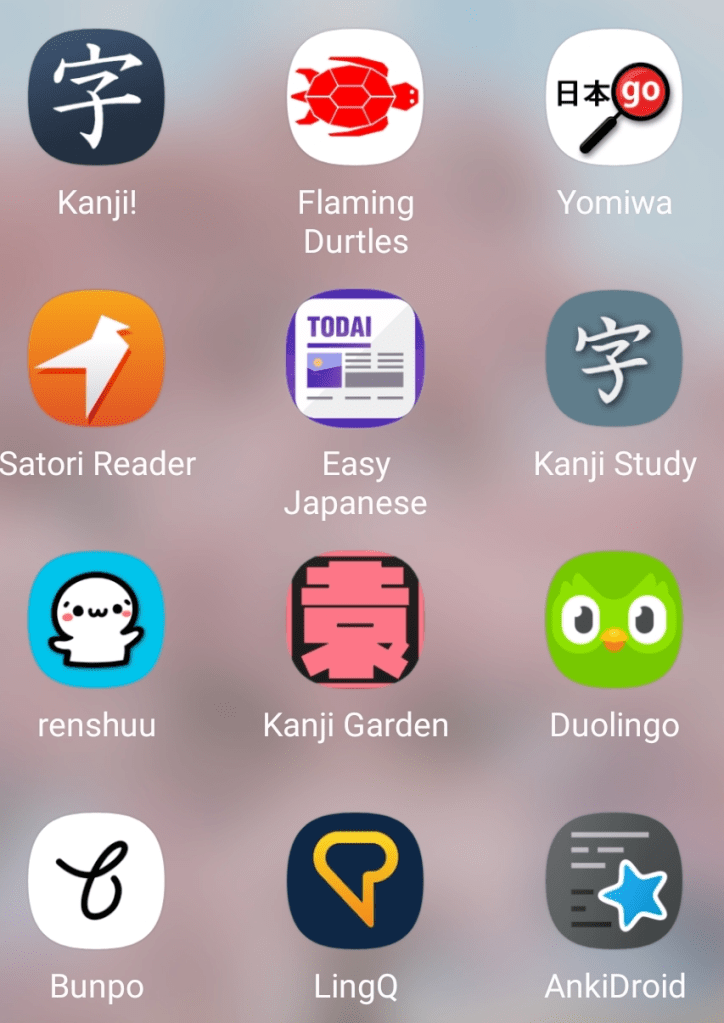
Kanji & Vocabulary
- WaniKani (the app is called Flaming Durtles): free until level 3, after level 3 you have to pay to continue learning. For me, this is the best app to learn kanji! Every kanji that I have learned through this app ( or as it is called in the app ”burned”), I cannot forget anymore. Through WaniKani my reading and recognition of kanji improved over the past two years. The downside of the app…..the reviews pile up and after a while, you find yourself way behind! I am still at level 7 and it is very hard to progress.
- Kanji!: great free app to learn kanji stroke order and practicing drawing the kanji. It covers all JLPT levels and has a clear design. The kanjis are ordered per level and you can always choose which one you want to learn first. It provides a review option based on SRS.
- Anki: SRS flashcard system. Not specifically designed for Japanese, but there is a large community behind this app who have developed multiple specific add-ons for learners of the Japanese language. In my opinion, this app has the best incorporated SRS and it is entirely free to use. It takes some time to get used to the app and all its functions, however, it is definitely worth the time investment. A more in-depth review is coming up…
- MochiKanji: focuses on kanji and vocabulary learning. The app interface is easy and fun to use, a bit too cute maybe. The app also uses SRS and provides audio and example sentences. There is a limited free trial, later you would have to advance to a paid plan.
- Clozemaster: a nice app for learning vocabulary, it does not provide you with single kanjis but only words in an example sentence with audio. The interface looks like a 90s game, which I personally like. There is a generous free version and a paid subscription with more options for learning. However, I think that the free version already provides the learner with enough possibilities for using the app.
- Kanji Garden: a paid app after a couple of free weeks. I think this one is less effective compared to WaniKani, but you can progress faster and the reviews are less difficult (as you can imagine, this leads to forgetting kanji and you need more time to really learn something in the long run). One thing that I love about this app: The Progress Wallpaper (see the picture below).

Grammar
- Bunpo: Japanese grammar app, after a couple of lessons you have to pay. The grammar explanations are short and clear, and you have the option to practice the grammar that you have learned ( also great for learning new vocabulary).
Reading
- TODAI Easy Japanese: an app to read Japanese news articles, you can use it for free. Great for reading practice, and you have every time something new to read in comparison to Satori Reader.
- LingQ: I use this one on and off. It is a good app for reading and listening, but it has some limitations with languages like Japanese and Chinese (languages with a different alphabet and especially languages with no spacing between words!). I would recommend it more for European languages; the approach would be very effective for these. It is also quite costly and the free version is very limited. When you are at a level in Japanese that you can recognize where a word ends and a new one begins, then the spacing issue is not so bad. And if you enjoy learning through immersion (watching videos and reading articles or books) then you would like this app because it allows you to import your own found content and to track your vocabulary knowledge.
- SatoriReader: one of the best apps for people who want to start out with reading in Japanese, very beginner friendly. You can read three chapters for free of every story but if you want to finish the story a paid version is needed. Not too expensive for the amount of information and details that they provide.
JLPT Preparation
- Migii JLPT: only focused on JLPT content, containing multiple exam preps. It even provides you with a roadmap; an individual schedule for you to achieve a specific JLPT level based on your current knowledge. To unlock all functions you would have to pay for the app, it is not too expensive compared to other apps and it is often on sale. I would only recommend this app if you are learning for the JLPT exam and want to measure your current level and see how much you still have to learn. If you do not plan on taking the exam, then there are better app options out there.
General Learning
- Duolingo: it is so quick and easy. It is certainly not the best learning resource, however, it does introduce me to new vocabulary and kanji. And it shows me how to build a good sentence, which I still find difficult in Japanese.
- Yomiwa: Japanese dictionary app. I prefer to use jisho.org as a dictionary. But Yomiwa is sometimes helpful because it saves the words you have looked up and you can make a review list of the vocabulary.
- LingoDeer: a better alternative for Duolingo in regard to Asian languages.
- Renshuu: an app that incorporates multiple aspects of the language: reading, writing kanji, SRS, lots of vocabulary, and grammar explanations. Also, multiple fun games and challenges that help your learning process and keep you motivated. Can be used for free, but the paid version has more advantages.
Obviously, over the years I have used more resources. But these are the ones worth mentioning. Even if I do not use some of them every day/week, I still come back to them frequently.
Discover more from MariaTheMillennial
Subscribe to get the latest posts sent to your email.
 MariaTheMillennial